
Eastchester Resident Lookup Records
A careful Eastchester resident lookup separates identity, ownership, court activity, and historical evidence. The county parcel layer is a current tax-roll source, not a household list. New York eCourts is a party-name index with court-specific coverage. The state voter tool is designed for a matched voter checking registration or poll information, not for browsing an address. Vital records have stricter gates than ordinary agency files. Using two unrelated sources helps reduce same-name mistakes, especially where a Town label, a village label, and a postal label may all appear in Westchester County records.
| Record source | Question it can answer | Custodian | Access route |
|---|---|---|---|
| Parcel layer | Current tax-roll owner, situs address, and mailing fields | Westchester GIS and Eastchester assessor | Free map layer; assessor follow-up for official roll detail |
| Recorded land index | Grantor, grantee, recording date, and legal description | Westchester County Clerk and Archives | WRO account route; Archives index, reading room, or mail research |
| Voter status tool | Matched registration, poll-site, or mail-ballot status | New York State Board of Elections | Individual self-service lookup, not a public roster |
| Court index | Caption, case number, court, and status when published | New York courts and local clerks | eCourts plus the relevant clerk file |
| Vital record | Birth, death, marriage, or genealogical fact | Eastchester Town Clerk or New York DOH | Eligibility, age, relationship, or court-order rules apply |
| License record | Official professional or State-issued license status | New York DOS or NYSED | Free official verification tools |
Start with the most solid fact already known. An address works well for a parcel check. A distinctive full name can begin with a court party search or an official license verification. For an older family question, a newspaper notice or a genealogy-eligible record may be more useful than a current roll.
Match an Eastchester Resident Name
Normalize a name before treating it as a match. Test middle initials, hyphens, apostrophes, married or former names, and common spelling changes. In Eastchester, also search the Town name and the Bronxville or Tuckahoe label that may appear on a record. Compare the street, ZIP, approximate time period, relatives, organization, or business connection shown by the source. A name alone is weak evidence in a dense Westchester setting.
The Eastchester parcel layer separates PROPADDRESS and related location fields from OWNERNAME and owner mailing fields. Its parcel keys include SWIS, SBL, PRINTKEY, and SWISSBL. Carry one of those keys into an assessor or clerk question when spelling or municipal labels conflict. The County warns that parcel lines are approximate and are not a survey. A tax mailing address can belong to an office, representative, estate, or another location, so it is an ownership clue rather than proof that a person lives at the property.
Note: A missing parcel match may reflect a name variation, a transfer, or a different municipal label, not a final answer about a person.
Eastchester Voter Lookup Limits
The New York voter lookup asks for county, last name, first name, date of birth, and visible ZIP or address information. It offers Poll Site Search, Voter Registration, and Mail Ballot Tracker functions. Its purpose is a matched voter’s status and polling information. It is not an unrestricted Eastchester resident lookup or a list of everyone at a street address. No live Eastchester result-card inventory was captured, so a result should be read only for the details the official tool actually displays.
The official voter form is useful because it shows the identity fields needed to avoid a loose name match.
New York’s voter-status service is shown below with its county, name, date-of-birth, and ZIP inputs.
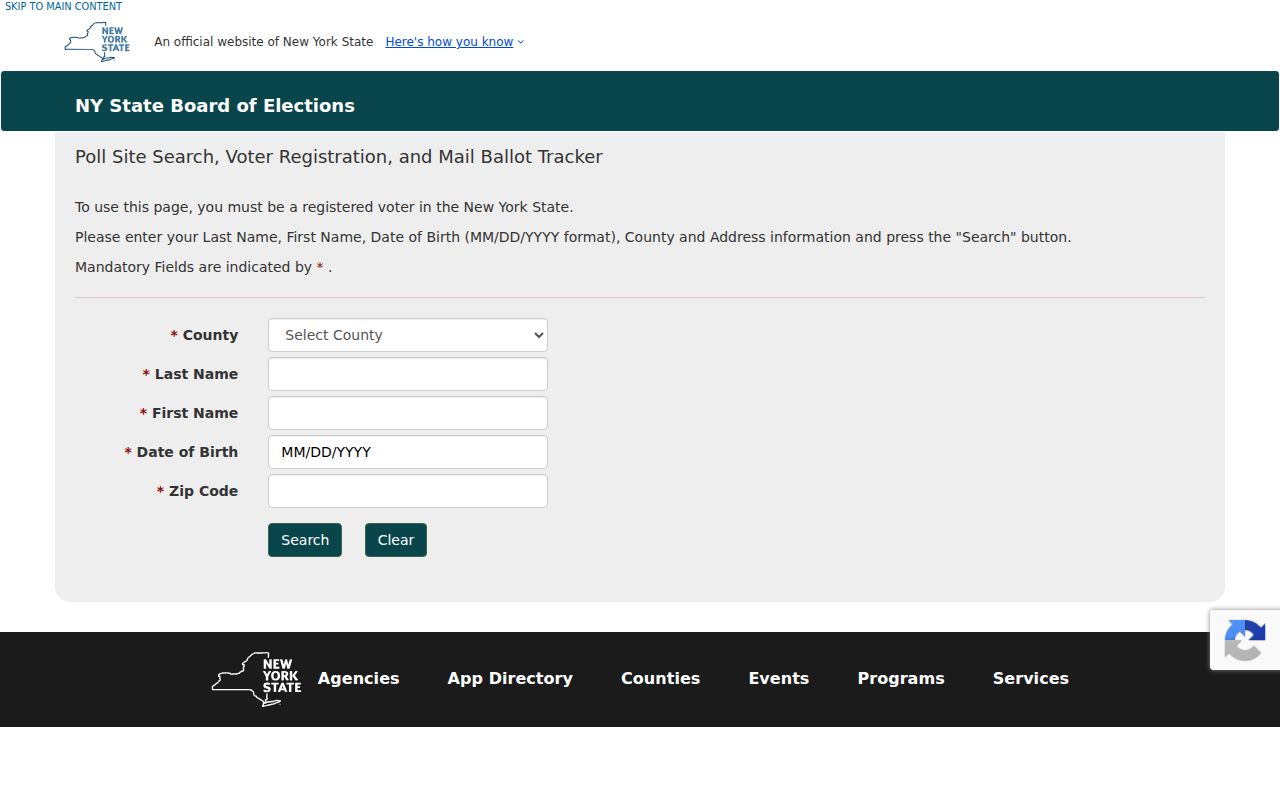
Use the visible fields exactly as requested, then keep any match limited to its stated registration or poll-information purpose.
| Visible field | Format or scope |
|---|---|
| County | Required selection from New York counties |
| Last and first name | Required text inputs |
| Date of birth | Required as MM/DD/YYYY |
| ZIP and address information | ZIP is visible; the rendered address fields were not fully captured |
Court Parties in an Eastchester Resident Lookup
New York eCourts has separate WebCivil Local, WebCivil Supreme, WebCriminal, WebFamily, and eSurrogate layers. WebCivil Local exposes Party Name, Attorney Name, Judge Name, court selection, case type, filing year, status, future-appearance, output, and party-role controls. WebCivil Supreme has its own civil coverage. A Town Court matter and a Supreme or County Court matter may therefore require different searches and a different clerk.
Record the case number or index number, caption, court, case type, filing or disposition status, and public appearance information only when it is visible. A docket is the court’s running list of case events. A party hit does not establish guilt, current residence, or the full contents of a file. Sealed, juvenile, adoption, and protected family matters are not ordinary public name-search material. For a file, certified copy, or archived record, ask the relevant clerk about the proper request channel rather than treating a web index as the complete court file.
Eastchester Vital-Record Gates
The Eastchester Town Clerk’s Permitium service lists certified birth, marriage, and death certificate choices alongside uncertified genealogical options. Local records are stated to date to 1842, but that does not establish that every record is digitized. The service lists a $10 record fee and a $5 nonrefundable online service fee, while the published mail display should be confirmed at checkout. Standard processing language says five to seven business days and the Town Clerk publishes weekday counter hours.
Eligibility matters. A certified birth record is limited to the named adult, a listed parent, a documented guardian of a minor, or a requester with a New York court order. Death and marriage requests have their own relationship or proper-purpose rules. The New York DOH genealogy route is for older statewide records outside New York City: births are generally available after 75 years when the person is known deceased, deaths after 50 years, and marriages after 50 years when both spouses are known deceased. The Department says processing can take eight months or longer, making the local registrar worth checking for an eligible Eastchester event.
Verify an Eastchester Resident Across Indexes
Cross-checking means asking two records to support the same identity in different ways. A parcel can connect a name to a current ownership record. A court caption, official license city, or dated historic notice can then test whether the name is the same person. Do not turn a single old address, a service address, or a tax mailing field into a current personal location.
- Write down the name variants, Town or village label, and one dated fact such as an address or organization.
- Search the parcel layer or voter-status service only in the way its official access rules allow, and preserve the parcel key or permitted status detail.
- Run the appropriate eCourts or eSurrogate name search, then compare the caption, court, date, and public case identifier with the first record.
- Use a Town Clerk, DOH, Archives, or clerk request only if the relevant eligibility and copy rules are met.
- Index
- A searchable list that points to a record. It may give a name, date, number, or caption without supplying the whole file.
- Image
- A scan or view of the underlying document. Westchester Records Online may require an account and remote-access terms before images or reports can be viewed.
- Certified copy
- A copy issued by the legal custodian for an eligible requester. It is different from an informational index entry or an uncertified genealogical transcript.
For a current street-wide records chain, the Eastchester street directory keeps the address workflow separate from a one-person verification.
Eastchester Resident License Names
Official licensing and entity tools can confirm an organization or professional affiliation, but they do not replace a residence record. The New York DOS public license search supports last name, first name, license type, county, city, and ZIP fields. The NYSED verification search can return profession, license number, location, original license date, registration or status, and discipline information for its covered professions.
New York DOS entity records can provide formation, jurisdiction, county, service-of-process address, and filing history. A registered agent, organization address, or license location is an affiliation clue. It is not proof of a person’s home. For an Eastchester business name, compare the published city or ZIP and the record date before drawing a connection.
Eastchester Resident History Bridges
When two people share a name, an older record can help set a date and family context. The Eastchester Historical Society newspaper archive covers title-specific runs from 1902 through later material in its continuing project. Search a surname with Eastchester, Bronxville, Tuckahoe, a street, or an organization. Advertisements, legal notices, school items, wedding or death notices, and club reports can provide dated clues, but their presence does not prove a current address.
The Westchester Historical Society collections add genealogy files, family histories, cemetery volumes, church records, and local newspaper marriage and death listings. Its reported holdings include more than 2,800 family files, 80-plus cemetery volumes, and about 30 church-record sets. These are strong bridges for family-history questions when a modern index is thin. They are not a current household roll.
Limits on an Eastchester Resident Lookup
Some gaps are deliberate. Protected voters may use confidential registration under Election Law §5-508. The New York Address Confidentiality Program can provide a substitute mailing address for qualifying people. Restricted vital certificates, sealed court material, DMV data, and protected addresses are not made public simply because another record names a person. A no-match can result from a spelling difference, a county or ZIP mismatch, a status change, or confidentiality.
Commercial neighbor and people-finding products are a separate category from custodial records. They can combine stale public filings, marketing data, and historical addresses, and may merge people with similar names. Check any claim against the original Town, county, state, or court custodian. If an agency record is wrong, use the custodian’s correction route, keep supporting identification, and state the precise error. A lawful historic index is not normally erased because it is inconvenient.
Lawful use. Use Eastchester resident records for personal, lawful research and verification. Do not use a name, address, or record detail to stalk, harass, intimidate, or harm anyone.
Eastchester Records Request Fallback
When a needed municipal administrative record has no published search, a narrow request can be more useful than a broad name search. New York’s Freedom of Information Law, Public Officers Law Article 6, §§84-90, applies to agency records subject to exemptions. Identify the agency, address or record type, date range, and preferred format. An agency generally must grant, deny, or acknowledge a request within five business days. An acknowledgment should give an approximate determination date, and the Open Government guidance describes a general 20-business-day outer expectation after acknowledgment, subject to a date-certain extension.
FOIL cannot require an agency to create a new resident list, answer a research question, bypass a vital-record rule, or obtain court files that follow Judiciary Law and clerk procedures. Paper copies are generally $0.25 per page up to nine by fourteen inches, while electronic copies may have no reproduction charge. A denial generally has a 30-day appeal window, with a determination due within 10 business days.
Note: State, county, Town, and court records have different custodians, so direct the request to the office that actually holds the item.