
Eastchester City Directory Shelves
The most specific verified shelf is the Bronxville History Center printed-materials collection. Its finding aid records a 1891-2019 holding, including resident and business directory material and extracts for 1891-1966 and 2000. It also identifies two Bronxville-information directories for 1916 and 1929, guides with later coverage and gaps, and the Handi-Book that explicitly includes Eastchester, Bronxville, Scarsdale, and Tuckahoe. That inclusion matters because an Eastchester household may be catalogued through a village collection rather than under a separate town volume.
| Verified collection | Years documented | Where held | Access route |
|---|---|---|---|
| Resident and business directories and extracts | 1891-1966; 2000 | Bronxville History Center | Finding aid, then shelf inspection or scan request |
| Bronxville information directories | 1916; 1929 | Bronxville History Center | Collection-level finding aid |
| Bronxville Guide | 1965-2012; 2019, with gaps | Bronxville History Center | Finding aid and local inspection |
| Bronxville Handi-Book | 1979-1985; 1983 missing | Bronxville History Center | Eastchester-inclusive historical reference |
The finding aid does not establish a single standalone Eastchester directory run. It also does not support filling absent years from adjacent volumes. The missing 1983 Handi-Book is useful negative evidence: compare 1982 and 1984 with a newspaper, deed, census release, or another dated record rather than treating the gap as proof of an address.
Eastchester Directory Years at Bronxville
The Bronxville History Center finding aid is a collection map, not an indexed transcription of every name. It describes 2.1 linear feet of printed materials, directory and telephone-book content, date ranges, and gaps. A first visit or request should identify the desired name, street, Town or village label, and approximate year. That lets staff locate a relevant item without assuming that every bound book has the same geography or fields.
Telephone books and guides can extend an address question, but their exact Eastchester runs were not separately verified. Public-library holdings are also incomplete in the available research. Tuckahoe Public Library and Eastchester Public Library are useful local contacts, yet the confirmed directory shelf belongs to the History Center finding aid. Asking whether an uncatalogued reverse book or telephone book exists is reasonable; claiming one exists before it is checked is not.
Note: A Bronxville catalogue label can still be relevant to an Eastchester address because the confirmed Handi-Book spans multiple local jurisdictions.
Eastchester City Directory Gaps in Print
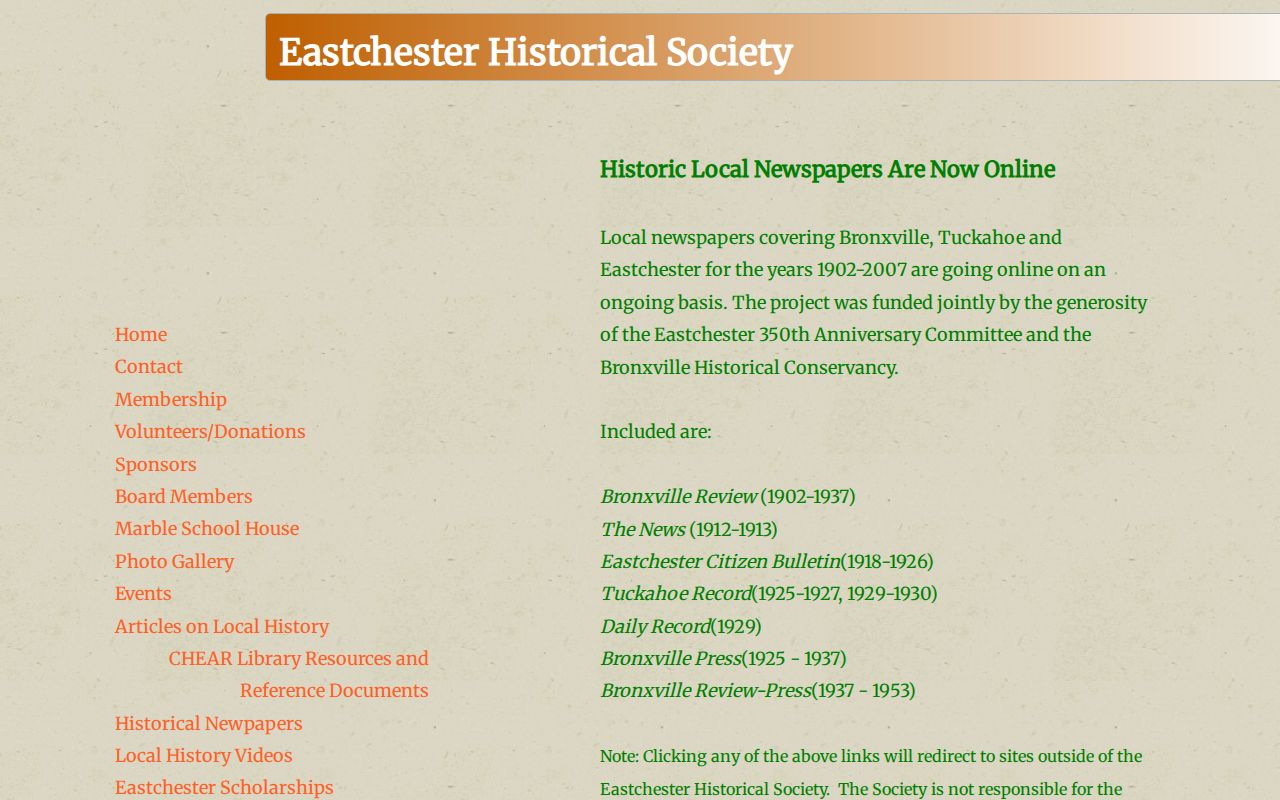
When a directory year is missing, the Eastchester Historical Society newspaper archive provides a dated continuity layer. Its title runs include the Bronxville Review from 1902-1937, The News for 1912-1913, Eastchester Citizen Bulletin for 1918-1926, Tuckahoe Record for 1925-1927 and 1929-1930, Daily Record for 1929, Bronxville Press for 1925-1937, and Bronxville Review-Press for 1937-1953. The project describes later local material through 2007.
The Eastchester Historical Society archive is the documented local source for this Eastchester city directory companion image.
Search a surname with a street, organization, or event term, then retain the issue date and page or image link. Advertisements and legal notices may place a person or address more precisely than an editorial item, but the result still belongs to that issue and does not establish a complete household list.
The Westchester County Archives digital collections add maps, photographs, and documentary collections. Their metadata may use Eastchester, Bronxville, Tuckahoe, a collection name, or a street. Search each form separately before deciding the historical trail has stopped.
Reading Eastchester City Directory Records
A historical directory is strongest when its printed information is read exactly as shown. The local finding aid confirms collection-level details, but it does not expose an actual scanned person entry. Name, spouse notation, occupation, address, status marks, widow notation, and the volume's abbreviation key were not verified for the Eastchester-area volumes. Inspect the bound page or a supplied scan before transcribing any of those fields.
| Title or series | Confirmed in the History Center finding aid. |
|---|---|
| Date range | Confirmed at collection level, with documented gaps. |
| Extent and coverage notes | Confirmed as finding-aid metadata, not person-entry data. |
| Name and address fields | Require inspection of the relevant printed page or scan. |
| Abbreviations and status marks | Not confirmed from an actual local entry sample. |
- Criss-cross directory
- A reverse directory arranged from address to occupant or name. A specific Eastchester publisher and run were not verified.
- Householder index
- An index that groups a household under a printed name or address; whether a particular local volume uses one must be checked in that volume.
- Abbreviation key
- The volume-specific guide to its shortened terms and marks. Photograph or note it with the entry because meanings vary by publication.
Eastchester City Directory Name Variants
Eastchester is legally a town in Westchester County, with the incorporated Villages of Bronxville and Tuckahoe. Historical search results can therefore use a Town label, a village label, or a postal label. Begin with the surname and one spelling of the street, then test Eastchester, Bronxville, Tuckahoe, and a Scarsdale-border reference when the history-center coverage calls for it. Normalize abbreviated street suffixes and house-number variants as well.
A publication's geography is not the same as a modern municipal boundary. The same caution applies to census records, which may use a township, village, or enumeration-district label from their own period. Keep the cited place wording alongside every result. It helps explain why one volume has a name that another index does not retrieve.
Eastchester's Long Records Timeline
Westchester's surviving land-record story reaches much farther back than its convenient online tools. The County Archives deed index begins in 1680, and the oldest surviving County Clerk record, Liber A, includes a will recorded in 1684. The Archives itself was established in 1984, its controlled vault and first archivist followed in 1985, and its public room opened in 1989. Those dates explain why early evidence and modern web access are separate layers.
- 1680: the County Archives deed-index coverage begins.
- 1684: Liber A contains the surviving recorded will of Philip Galpin.
- 1891: the confirmed Bronxville-area directory holding begins.
- 1984-1989: the County Archives was established and then opened its public reading room.
Courthouse fires in Bedford in 1758 and White Plains in 1775 belong in that context, but they do not justify a blanket claim that all county books vanished. Surviving Liber A and the Archives indexes show that the older record trail still deserves a search.
Trace Eastchester City Directories Across Years
Use each city directory as one dated observation, then test it against independent records. Start with the earliest confirmed volume near the family's known date and record the exact printed name, address, locality label, and page. Work forward or backward only through volumes that actually exist. A directory may have been compiled before publication, a deed records a legal transfer, and a census captures people on its enumeration date. Their agreement narrows a household window without proving an exact move day.
- Locate the name in a confirmed History Center volume and preserve the year and page.
- Compare the next available directory year, while keeping the 1983 Handi-Book gap explicit.
- Use the address, alternate locality labels, and street variants to look for a matching newspaper notice.
- Pair the closest released federal census schedule with the printed directory year and its historical geography.
- Compare a deed's legal description when an ownership change needs confirmation.
For a modern verification step, historical material should be corroborated through the appropriate current custodian rather than treated as current residence evidence. Address-keyed current parcel work belongs with the Eastchester street directory, while the historical collection remains the useful bridge between dated records.
Eastchester Family History Bridges
The Westchester Historical Society collections can resolve a gap between directory appearances. Its resources include more than 600 family histories, more than 80 cemetery volumes, about 30 church-record sets, local newspaper marriage and death listings for 1828-1896, and genealogy files on more than 2,800 families. These are historical leads, not a current resident roll, but they can support a dated identity or family relationship when a directory does not.
County digital collections also list named resources such as McDonald Interviews, the 1929-31 Atlas, Veterans WPA Cemetery Records, French Scrapbooks, the Odell index, and Mackenzie Families of Colonial Manor of Philipsburg. Search the collection name alongside a place, street, or surname. A result should retain its collection metadata because it may describe a person, photo, cemetery, or map rather than a household.
Note: Federal census schedules become public under a 72-year rule, so the available year depends on the release calendar.
Eastchester City Directory Access Routes
Start online with the History Center finding aid and the Eastchester Historical Society's full-text newspapers. For a printed directory entry, move to the History Center shelf or request a scan after identifying the volume and date. County Archives digital collections offer another web route for maps, photographs, and documentary materials. When those tools do not answer the question, the County Archives reading room and Westchester Historical Society reading-room and finding-aid access provide the documented in-person alternatives.
The Archives reading room is public Tuesdays and Wednesdays from 9:00 a.m. to 4:00 p.m., except holidays. Researchers register, use lockers, and submit call slips; the published practical limit is three items at a time. Its reference staff are at 2199 Saw Mill River Road, Elmsford, NY 10523. Call before traveling because hours and retrieval availability can change.
Archives research by mail is available for historical deed, mortgage, estate, and map index work when an older address needs another source. The research does not verify a complete public-library directory shelf, a local reverse-directory run, or an Eastchester yearbook collection. Direct confirmation from the relevant library or history center is the reliable next step for those unverified holdings.